
A couple in Bengaluru searches for an outdoor wedding venue near the airport with room for 150 guests. They might see a map listing, a venue page, or an AI-generated answer with links. The venue needs to make one thing easy to verify: can it host their event, and how can they enquire?
That is the heart of local SEO for AI search in 2026. Search formats are changing, but customers still need accurate location details, a clear offer, trustworthy evidence and an easy next step. This guide uses a wedding venue as an illustrative example; the same method works for hotels, schools, clinics, showrooms and local service businesses.
Search has more answer formats. The fundamentals still matter.
Google’s AI Overviews and AI Mode can show supporting links alongside generated answers. Google says its existing SEO best practices still apply: make important content crawlable, useful, original and available as readable text. A page must meet Google Search’s indexing and snippet requirements to be eligible as a supporting link, and eligibility does not guarantee an appearance. Read Google’s guidance on generative AI search ↗
Translate the trend into a customer question
“Can you host 150 guests near the airport, and what happens after I enquire?” A useful page answers that directly with real details and a clear enquiry path.
Terms such as AEO and GEO describe attempts to improve visibility in answer-based search. They do not create a separate shortcut for Google. Its own advice is to keep investing in strong SEO and distinctive, people-first content instead of special AI files or formulaic text.
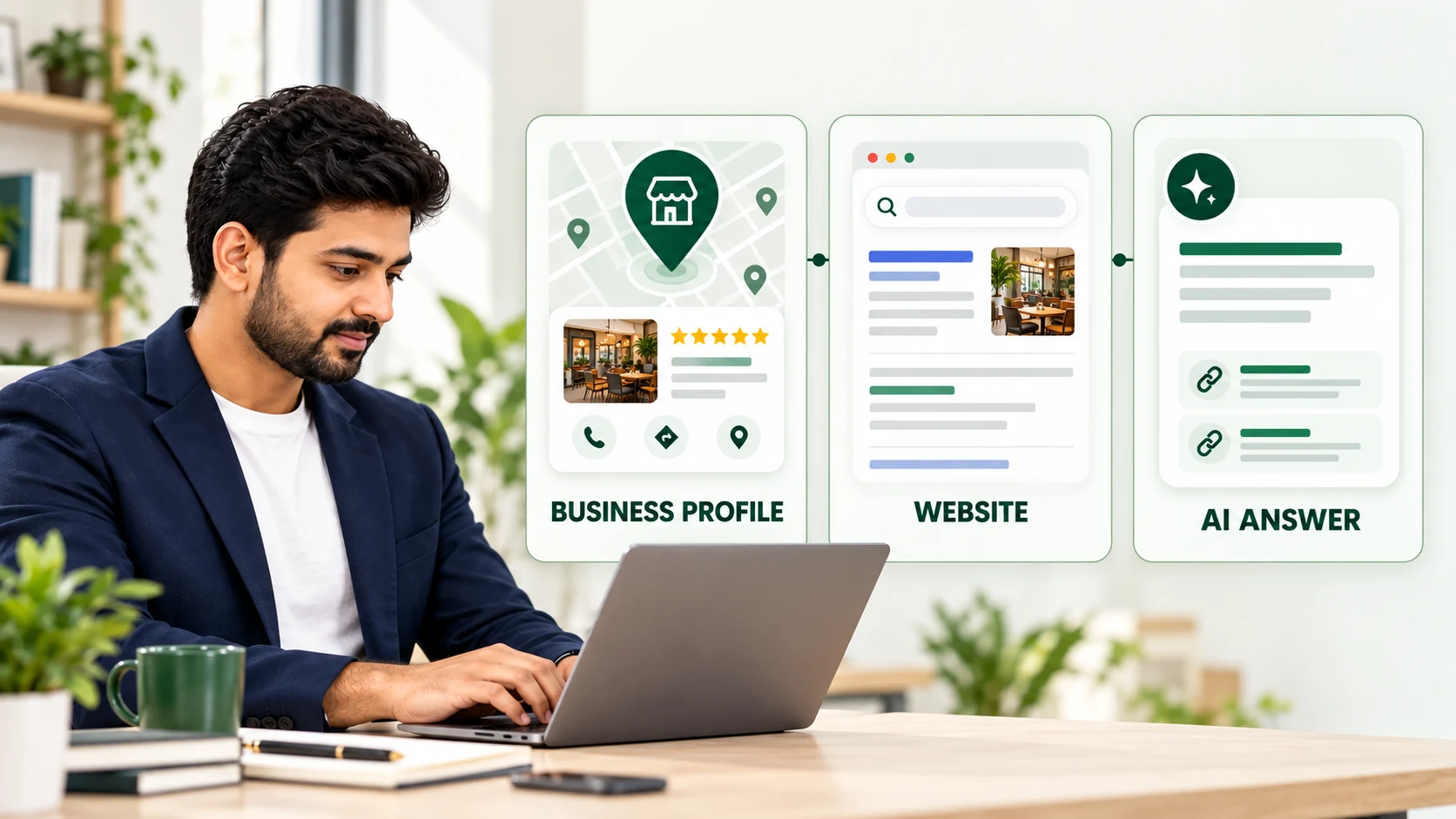
One customer question can lead to three different discovery paths.
The result changes with the query, location and search experience. Treat the paths below as a planning map, not a promise that every search shows all three.
Location, category, hours, photos, reviews and contact details.
Capacity, facilities, event examples, pricing approach and enquiry form.
A summary may point to relevant pages that help answer the question.
The practical job is to make the underlying facts consistent across your profile and website. For a venue, “outdoor space” is too vague. A customer also needs guest capacity, location, parking, covered backup options and a way to request availability. If those details are missing, a polished image alone cannot answer the search.
Make your Google Business Profile complete and accurate.
Start with the facts customers can check: the correct business name, primary category, address or service area, phone number, website, normal hours and special hours. Add current photos that actually represent the place or service. If an attribute is relevant and available in your profile, complete it accurately.
Google says local results are mainly shaped by relevance, distance and prominence. Complete information can help it understand what you offer; distance depends on the searcher’s location; reviews and other signals contribute to prominence. There is no way to pay Google for a better organic local ranking. See Google Business Profile’s local ranking advice ↗
Match the place
Show the actual location or service area and keep directions useful.
Keep it current
Update hours, contact routes and photos when the business changes.
Earn trust
Ask genuine customers for reviews and respond helpfully, without incentives.
For the venue, compare the profile with the website on a phone. If one says “near the airport” but the other has no address, map, travel context or working call button, fix the gap before producing more blog posts.
Publish a service page that answers a specific buying decision.
A strong local page explains what you offer, who it fits, where you serve and what happens next. For a venue, useful sections might cover capacity ranges, indoor and outdoor spaces, parking, accessibility, catering policy, weather contingency and the enquiry process. Add real photographs with descriptive alt text. Make the enquiry button visible on mobile.
Write from actual knowledge. If capacity varies by layout, say so. If pricing depends on date and package, explain what affects a quote instead of inventing a starting price. One honest page built from the sales team’s real questions is more useful than many thin pages repeating the city name.
Use descriptive page titles and headings, link the page from your navigation, and check that it is indexable in Search Console. If you add structured data, keep it faithful to the visible page. Google says there is no special AI schema or llms.txt requirement for its AI search features. See how our SEO service approaches the foundation ↗
Make the business believable beyond its own claims.
Useful local proof is specific. Show recent, permission-cleared examples; explain the type of event or project; include location context; and answer the questions people raised during real enquiries. A venue gallery should identify which room or lawn is shown. A manufacturer might publish product specifications and dispatch areas. A school might explain admissions steps and campus facilities.
Keep your profile, website and public contact details aligned. A genuine review and a clear response can help a customer decide whether to call. Do not fabricate testimonials, buy reviews or claim capacities and service areas that your team cannot deliver.
Look beyond visibility to actual customer conversations.
A timely change in 2026 is Google’s dedicated Generative AI performance report in Search Console. Google announced it in June and says the insights had rolled out worldwide by 31 August 2026. The report shows impressions for site URLs in generative AI features, plus pages, countries, devices for Search and trends over time. It is a visibility view; an impression is not a qualified lead. Read Google’s report announcement ↗
Review the evidence together. A rise in impressions without better enquiries may mean the page is being seen for broad questions while its offer or contact path needs work. Record enquiry source where you can, but do not treat a single report as a complete view of the customer journey.
A manageable 30-day local search plan.
Check the Business Profile, mobile contact links, hours, service area and top landing page.
Choose one high-value service. Add real answers, location context, photos and a clear enquiry route.
Publish a permission-cleared example, refresh relevant photos and respond to customer reviews.
Check Search Console, website actions and enquiry quality. Fix the next biggest gap.
This is a work sequence, not a ranking guarantee. The priority may be different for a hotel, school or B2B supplier. Begin with the part of the customer decision that your current information fails to answer.
Common questions about local SEO and AI search.
Can I guarantee that my business will appear in an AI Overview?
No. Google says meeting its technical and quality guidance does not guarantee crawling, indexing or display. Focus on helpful information and a working customer journey.
Do I need a separate “AI SEO” website?
No. Improve the same pages customers and search engines already use. Make important details accessible, accurate and easy to navigate.
Should I create many city pages to cover every nearby search?
Only where each page genuinely helps a distinct local audience. Repeating the same text with a changed city name gives customers little value and can create duplicate or thin content.
Be the easiest credible answer to a real local question.
Keep your business facts accurate, explain your offer with real detail, show proof and make enquiries simple. Then measure whether the right customers are finding you.
Plan your local search improvements ↗Platform claims were checked against Google Search Central’s AI guidance, Google Business Profile guidance and Google’s Search Console announcement on 12 October 2026. The venue scenario is illustrative, and the cover artwork is an illustration, not a photograph of a client.